

Fujifilm’s Lars Petersen on trust-based partnerships and a ‘people first’ culture
Posted: 14 January 2026 | Dominic Tyer (European Pharmaceutical Review) | No comments yet
Named CEO of the Year at CPHI Frankfurt, the CDMO’s head talks about the type of company he and his team are building.
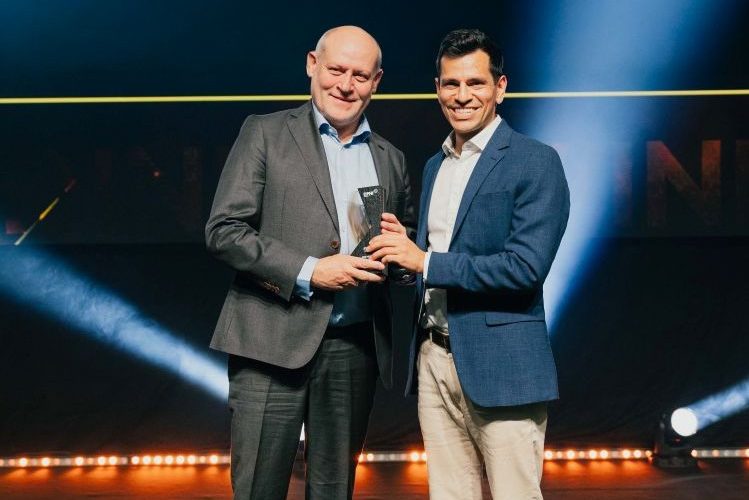
Halfway through last Autumn’s CPHI Europe exhibition, the event that welcomed more than 60,000 people to the Frankfurt Messe complex of halls paused to celebrate innovation, excellence and collaboration at the CPHI Pharma Awards.
Designed to recognise industry pioneers who are shaping pharma’s future across drug development, manufacturing and sustainability, the ceremony’s most prestigious category is CEO of the Year, which acknowledges outstanding leadership within the industry.
At Frankfurt that award was presented to Lars Petersen (pictured above left), President and CEO of the contract development and manufacturing organisation (CDMO) Fujifilm Biotechnologies.
Now two years into his time heading up the CDMO, Petersen’s CEO appointment was an internal one and built on the four years he served as Chief Operating Officer for Fujifilm Biotechnologies’ Hillerød site in Denmark, as well as head of the company’s large-scale strategic business unit. Prior to joining the organisation in 2019 he held leadership positions at Biogen, Novo Nordisk and Genentech/Roche.
The day after the CPHI Pharma Awards ceremony, Petersen sat down with EPR Editor Dominic Tyer in the bustling Frankfurt Messe to talk about the award, his approach to leadership and the type of company he and his team are building.
EPR: What has been the guiding force since your 2023 appointment to CEO?
Lars Petersen (LP): We decided as a company that we want to make sure we build a company for people, and we are in a regulated industry where complexity is very often big. You have lots of procedures, lots of processes, [it’s] very easy to build bureaucracy.
[So] how do we make sure to build a company that is based on people-first? People values, people attitude, people who always focus on the right purpose for what we try to do, and don’t get carried away by [being in] an industry of processes and procedures, [which] can quickly take over – and you do not necessarily like to work in an environment where control is taken away from you completely.
That said, if you have a regulated industry, of course, we need the recipe of how manufacturing is to be done in exact order as prescribed. But many work processes for you as a person, don’t have to be procedural.
How far is it possible to extend that idea of individuality across your workforce?
LP: The more we can utilise people’s differences – every person has a uniqueness to them – [the better]. So, how to focus on that at the same time as focusing on their purpose? If we can create a company like that, we believe we can better attract people, we believe the result is much better, and then [we can] instead build the systems and processes to fit how people like to work as much as possible. That’s really what we try to do. And I believe that’s a lot to do with getting this award, because people have recognised that we are a very people-driven, purpose-driven company.
So, if that’s the theory, what have you done in practice to ensure it really does run through the culture of the company?
If we can create a company [that focuses on people’s differences at the same time as focusing on their purpose], we believe we can better attract people, we believe the result is much better, and then [we can] instead build the systems and processes to fit how people like to work as much as possible”
LP: We have done multiple things. First, we created kind of a compass. We call it the Nine People Fundamentals, [which] in certain order, talks about how we show up, how we present ourselves – very much like psychological safety, empowerment, trust – how to work as teams and not in hierarchy. So we have a couple of [things] that direct what we should try to do as managers for our staff.
And then, training-wise, we make sure that the HR department knows what to look for, how to hire people, how to look into people – not necessarily focusing on your competences and your experience first, but focus on the attitude and the values first.
Of course, you need to teach yourself how to listen to that, because in our industry, everybody would say, ‘Oh, trust is very important, you write it all over the walls’. But the more you write it, the less you likely have it. So [we consider] how to get into that core of what we all want to get into – and that is only a beginning for us. We work on this very heavily, but that is what leadership wants to do here.
You can also help by changing some of the processes and systems and not creating systems and processes for everything. I used to say, “When you begin to put a note on your refrigerator that you need to remember to empty this every two weeks, you’ve gone far too long in creating processes, just because you can”. And the more you create of that, the more processes are taking over.
Instead of everything becoming a machine, [it’s about] how to remove tedious processes that don’t create value to patients, but just create systems to manage people.
As you remove unnecessary processes, what does that mean for the way employee performance is assessed?
LP: We are in the process, with all our sites, of removing Bell Curve assessments of people’s performance. Instead of having a process where you calibrate every single person towards a given system – which is almost impossible, because people are working differently – so instead of rewarding that with a complicated system, reward the entire team for what they do. Accept that maybe there’s two people sometimes who are not the highest performers, and some of the two highest performers do not necessarily get the highest bonus, because [instead] we all get a team bonus. In this way, you create much easier processes and allow people to be different.
And what results have you seen from that approach?
LP: After we removed these individual performance systems, performance has actually gone up. So why were the systems then in place? Just to reward the two percent or to punish the 80 percent who don’t get an exceptional rating?
The fact is, now we have transparency. Nobody gets cheated. Everybody knows everything. It’s not that we don’t have differences in salaries now; it depends on your level and that’s also transparent. And it’s not that you don’t get promoted to be good. People will recognise if you’re good; you just don’t have to write it down.
Many companies today, they don’t lead anymore, they just follow instructions. We have many people who come from regulated industries like life science, who say, ‘I’m just following instructions’. [But] even at the very high level, people are not leading people; they’re leading people through documents, which is almost impossible.
There’s plenty of ways to approach leadership in the life sciences industry, what does the ideal look like to you?
LP: When you say, ‘What is a perfect leader?’ You normally list 20 things, and when you look at those 20 things, that person does not exist. So why look for the ‘perfect’ leader, when we can lead in many different ways?
My ideal leadership is that you embrace the diversity, you focus on the task and you understand that you are as a leader a ‘servant leader'”
My ideal leadership is that you embrace the diversity, you focus on the task and you understand that you are as a leader a ‘servant leader’, and empowerment is the best and only way you can really develop people. The more you empower them, the more they take responsibility (and if they do not take responsibility, of course you have to have a dialogue).
It’s all about making sure people can drive their work day as much as possible, which is also why we don’t think it’s a good idea to have a very rigorous [approach of] ‘now you have company goals and now we have everything in an Excel sheet, and now we cascade them down to every function until they hit the person on the floor’. Because the moment they hit the person on the floor, they are too old, or the person cannot recognise them.
It’s much better to tell them ‘this is the purpose, this is the direction we as a company are following – define your own goals’.
About the author
Dominic Tyer is the Editor of European Pharmaceutical Review. You can connect with him at LinkedIn or follow him on Bluesky.
Issue
Related topics
Biopharmaceuticals, Contract Development and Manufacturing Organisation (CDMO), Contract Manufacturing, CPHI, Drug Manufacturing, Industry Insight, Interviews, Manufacturing, Outsourcing