



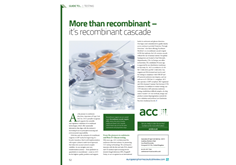
Download this guide to explore how recombinant cascade reagents support the transition from traditional Limulus amebocyte lysate (LAL) testing while maintaining consistency, compliance and performance.

As the industry moves towards more sustainable and animal-free testing methods, recombinant technologies are supported by growing scientific and regulatory validation.
However, the inclusion of recombinant reagents in USP marks only the beginning of a broader transition. Moving from traditional Limulus amebocyte lysate (LAL) methods to recombinant approaches requires careful consideration of multiple variables and a phased implementation strategy.
This guide explores what that transition means in practice.
In this guide you will:
- Understand the transition from traditional LAL to recombinant endotoxin testing approaches
- Learn how recombinant cascade reagents replicate the full LAL enzyme cascade
- Explore key considerations when transitioning from qualitative to quantitative to recombinant methods
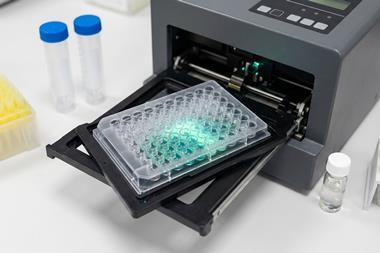
- Find out how recombinant cascade reagents can be used with existing instruments and preparation steps
- Understand how to approach implementation within current regulatory frameworks.
Recombinant reagents are not all the same. Recombinant cascade reagents mimic the full LAL cascade, enabling laboratories to use existing instruments and preparation steps while moving towards animal-free testing.
Understanding how these technologies differ and how they can be applied in practice is critical as organisations begin to plan their transition strategies.
Download the guide to explore how recombinant cascade technology can support your endotoxin testing strategy and help you navigate the transition.
Download Now








No comments yet