



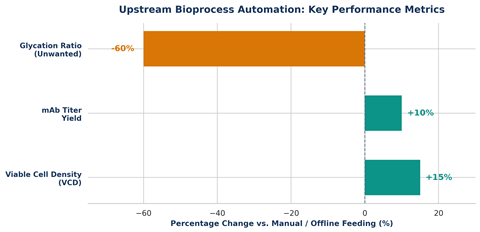
Drawing on findings from a technical webinar presented by Dr Nimesh Khadka of Thermo Fisher Scientific, this report examines how the integration of Raman spectroscopy and advanced chemometric modelling is enabling manufacturers to replace discrete offline sampling with continuous, autonomous process control — achieving a 10% uplift in mAb titer, greater than 60% reduction in glycation and approximately 30% savings in buffer consumption.

The transition from traditional offline sampling to real-time, autonomous process control represents the most critical strategic frontier for modern biopharmaceutical manufacturing. In an environment defined by intensifying market competition and rigorous regulatory scrutiny, the ability to eliminate the analytical “blind spots” inherent in manual, discrete assays is no longer a luxury—it is a prerequisite for operational excellence and compliance.
This report synthesises the core findings from the technical webinar, ‘Optimising Efficiency and Yield Through Bioprocessing Automation’, examining how Raman spectroscopy is being utilised to bridge the gap between reactive monitoring and proactive, data-driven control.In the session, Dr Nimesh Khadka, Senior Application Scientist at Thermo Fisher Scientific, provided a deep dive into the evolution of Process Analytical Technology (PAT). Specialising in the deployment of spectroscopic solutions and chemometric modelling, Dr Khadka’s analysis moves beyond theoretical benefits to provide evidence-based results on how automated workflows fundamentally improve the economics of both upstream and downstream processing. The following sections detail the technical specifications and quantitative strategic impact of implementing these advanced Raman-based ecosystems.
Executive summary: From discrete snapshots to continuous insight
The strategic integration of Raman spectroscopy marks a pivotal shift in biomanufacturing, moving the industry from “snapshot” data—often delayed by hours or days—to continuous, high-fidelity insight. This real-time visibility allows for high-frequency adjustments that stabilise the culture environment, directly translating to improved product consistency and reduced operational risk. By removing the lag associated with traditional analytics, manufacturers achieve a level of process “tightness” that was previously unattainable, ensuring the process behaves exactly as designed.The quantitative outcomes presented underscore the substantial value proposition of Raman-driven automation:
-
Upstream Yield Improvements: A 10% increase in monoclonal antibody (mAb) titer and a 15% improvement in viable cell density (VCD).
-
Enhanced Product Quality: A reduction in glycation of more than 60%, achieved through superior metabolite control.
-
Downstream Efficiency Gains: Approximately 30% savings in buffer consumption during diafiltration by identifying real-time endpoints.
-
Operational Autonomy: Demonstrated success in maintaining a continuous, fully autonomous perfusion process for 19 days.These performance gains are predicated on a foundation of hardware reliability and the deployment of robust predictive models.
Foundational instrumentation and the strategic necessity of model transferability
For any PAT strategy to scale across a global manufacturing network, instrument reliability must be treated as a strategic prerequisite. The selection of the 785 nm excitation source in the MarqMetrix All-In-One Raman analyser serves as a strategic compromise to mitigate the high fluorescence background typical of mammalian cell culture media while maintaining sufficient Raman scattering intensity for sensitive measurement.The instrument’s small footprint and interchangeable probes facilitate seamless scalability from R&D to GMP environments where cleanroom space is at a premium.
Crucially, these analysers feature factory-level X and Y-axis calibration. This stability is the direct enabler of the “holy grail” of spectroscopic deployment: model transferability. In a validation study involving 10 different instruments, models built on a single unit were deployed across the others with exceptionally low prediction error and high linearity. This ensures that expensive process data and modelling efforts can be leveraged across an entire production fleet rather than being confined to a single bioreactor.
Advanced upstream control: Simultaneous multi-component monitoring
In upstream processing, maintaining a steady-state environment is essential for the health of delicate cell lines. Closed-loop feedback control enables the autonomous adjustment of nutrient feeds based on real-time metabolic demand. The true strategic value of Raman in this context is the ability to measurement multiple critical process parameters simultaneously from a single scan.Using Partial Least Squares (PLS) algorithms, specific models were developed for glucose and lactate.
For glucose, the model utilised three distinct spectral regions: 1065–1232 cm⁻¹ (C-O and C-C stretching), 1595–1863 cm⁻¹ (the water band), and 2700–3100 cm⁻¹ (C-H stretch). This simultaneous tracking enabled an “Advanced Control” logic where the total carbon (the sum of glucose and lactate) was maintained below 2 g/L—a strategy impossible to execute with discrete sampling.The LICOS PAT software serves as the closed-loop feedback ecosystem, providing OPC-UA capabilities and ensuring cGMP compliance. This software communicates Raman predictions to the DeltaV platform, which manages the bioreactor’s pump speeds in real time.
Transitioning from cell culture to harvest, these same principles are applied to mitigate bottlenecks in purification.
Mitigating downstream bottlenecks: Analyte specificity vs. traditional UV
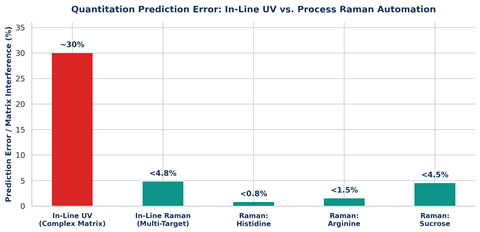
Raman spectroscopy offers significant strategic value in downstream ultrafiltration and diafiltration (UF/DF) by tracking multiple components simultaneously, including protein and exipients. The precision of these models is reflected in the following prediction error rates:
-
Protein: <5% error.
-
Histidine: <1% error.
-
Arginine: ~1.5% error.
-
Sucrose: <5% error.
Raman provides a distinct advantage over traditional inline UV monitoring, which is often susceptible to matrix interference. Specifically, amino acids like tryptophan can cause up to 30% error in UV protein readings. Because Raman is analyte-specific and focuses on distinct vibrational modes, it bypasses these interferences.
Advanced insights gained here include the ability to track volume exclusion effects and the Donnan effect during concentration stages. Raman even serves as a real-time monitor for buffer quality; for instance, detecting when sucrose has degraded into glucose and fructose. Economically, “real-time endpoint detection” allows diafiltration to stop based on actual measured concentration rather than empirical “diavolumes,” resulting in ~30% buffer savings.
Operational implementation and regulatory alignment
The adoption of PAT reflects a broader industry shift toward Quality by Design (QbD) and smarter manufacturing workflows.
-
Regulatory Alignment: While not an absolute requirement, continuous PAT aligns with FDA recommendations for tighter process control to ensure consistent product quality.
-
Engineering Reliability: To prevent biofilm coating during long-duration runs (19+ days), probes are engineered with specific anti-fouling surfaces to maintain signal integrity.
-
Robust Chemometric Design: Building robust models, particularly for titer, requires a “Uniform Design” of experiments (DOE). This strategy spreads data points equally across factors to capture process variations more effectively than a high volume of raw samples.
-
System Flexibility: The hardware supports various optical fiber lengths and interchangeable probes, allowing the same analyzer to adapt to different bioreactor orientations or process streams with minimal reconfiguration.Through the integration of these technologies, the industry is moving toward a “smart bio-manufacturing” future where automated, data-driven control is the standard for operational excellence.
Speaker biography
Dr Nimesh Khadka is a Senior Application Scientist at Thermo Fisher Scientific. He holds a PhD from Utah State University, where his research focused on enzymology and spectroscopy. With over five years of experience in the field, Dr Khadka specialises in the implementation of Process Analytical Technology (PAT) and the development of complex chemometric models to support process development teams in the biopharmaceutical industry.






No comments yet