



Tim Sandle explores the main factors that influence particle accumulation in pharmaceutical cleanrooms, advising how best to control risks and minimise operator contamination.
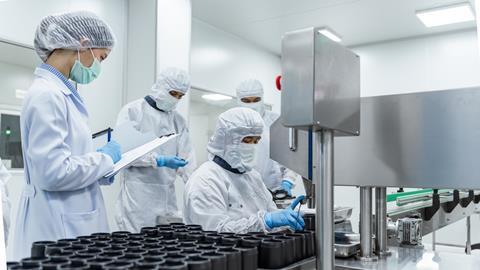
Operators are the primary source of contamination release in a typical cleanroom. Assuming that an appropriate gown is worn, there are two primary risks: the number of operators present in the cleanroom (which increases the concentration of particles and rate of release) and the behaviour of the personnel (where rapid movements increase particle release).
This article explains how risks are elevated, especially as operators position themselves closer to ‘working surfaces’ – ie, critical horizontal surfaces. The objective is to present information that could be conveyed to operators as part of training reinforcement.
Cleanroom design and control
Numerous factors impact cleanroom suitability, including fabric, air filtration, air movement and exchange, pressure, temperature, humidity, noise, operator gowning, operator movements, cleaning frequencies and so on.1-3 The optimal design of a turbulent flow cleanroom is to control the generation of airborne particles, keep these particles in suspension and facilitate their removal; thus, the airflow pattern must be optimised to minimise a concentrated buildup of particles and prevent their accumulation in any given space.4 The cleanroom should also minimise the deposition of particles onto horizontal surfaces – a requirement that becomes more challenging for larger particles. Contributing factors are the positioning of ceiling-mounted air supply inlets and side-located air removal outlets.5 There must also be a sufficient number of outlets,6 since particles generated close to an outlet are easier to extract than those generated further away and which need to traverse.7
The optimal design of a turbulent flow cleanroom is to control the generation of airborne particles, keep these particles in suspension and facilitate their removal”
Operator contribution
Once the design has been optimised and equipment suitability assessed, an inevitable variable within pharmaceutical cleanrooms is operator activities.8 This includes gown quality, changing room design and personnel activity.
Personnel disperse fragments from their skin and particles from their clothing. Each operator therefore contributes to the buildup of the particle concentration – irrespective of the efficiency of the cleanroom suit, all operators will generate particles.9 In terms of the number of operators in a cleanroom, there is an increase in particle generation by a factor of two between two and three operators being present in a cleanroom.10 Another factor is movement.
irrespective of the efficiency of the cleanroom suit, all operators will generate particles”
The rate of particle release of a motionless operator is lower than a slow-moving operator. Moreover, slow movements generate fewer particles than faster movements – typically, with ≥0.5µm particles:
- · Operator is motionless: ~100,000 particles per minute
- · Slow walking (2 mph): ~5,000,000 particles per minute
- · Active work/movement (> 5 mph): Up to 5,000,000+ particles per minute.
The extent to which this level of particles presents a problem depends on the grade of the cleanroom and its efficiency design factors.11 The generation of larger particles – ≥5µm – increases the more an operator moves.12 This is significant since microorganisms in cleanrooms are carried on larger particles, which act as rafts of matter (such as skin detritus or clothing fibres). It also stands that larger particles are more likely to settle. In terms of likelihood, the ratio of ≥ 5µm inert particles to microbial-carrying particles is 210: 1, with a dispersal rate of 177 particles per minute wearing a standard cleanroom gown.13,14 Table 1 puts the particle levels and deposition rates in context.
Table 1: Effect of operator movement on airflow behaviour and particle dispersion
|
Operator Activity Level |
Representative Motion |
Airflow Pattern |
Airflow Stability |
Particle Behaviour |
Contamination Risk |
|
Stationary |
Standing still |
Uniform vertical (↓ ↓ ↓) |
High stability |
Particles remain entrained and are efficiently removed |
Low |
|
Minimal disturbance |
Limited lateral spread; minimal recirculation |
||||
|
Slow Movement |
Walking (~2 mph) |
Slight deflection (↓ ↘ ↓ ↙ ↓) |
Moderate stability |
Localised mixing zones form; partial disruption of laminar flow |
Moderate |
|
Minor turbulence |
Increased particle residence time near operator |
||||
|
Fast / Active Movement |
Rapid movement (>5 mph) |
Turbulent / vortex (↺ ↑ ↻ ↘) |
Low stability |
Recirculating air zones trap particles; lateral spread increases |
High |
|
Strong disruption of airflow |
Particles linger and deposit, especially ≥5µm (microbial carriers) |
Operator movement is a concern because it creates ‘circulation zones’ – these last longer the faster a person moves or the more active their movement.15 Their generation is linked to heat transfer rates from the body, especially from the head.16 Moreover, when personnel work close to a working surface, larger particles will gravitate towards and become deposited on the surface.17
The risks presented are reduced under unidirectional airflow; however, it is relatively easy for an operator to disrupt ‘first air’ and hence counter the protective effect of the air curtain. Consequently, when devices like isolators and RABS are set up, operator training is essential to minimise particle ingress.
Summary
Operator-related risks are dynamic and behavioural. The key control levers are minimising personnel, restricting movement, maintaining distance from critical zones and reducing direct intervention through barrier technology. The key points to note are:
Operator presence
- Each operator contributes to cumulative particle load, regardless of gowning efficiency
- Increasing personnel significantly elevates contamination risk, with the largest step-change occurring between two and three operators.
Particle generation from the human body
- Operators continuously shed particles from skin and garments
- Even with cleanroom clothing, microbial-carrying particles are emitted, albeit at reduced levels.
Movement and activity level
- Particle release increases dramatically with activity:
- Low when stationary
- Much higher during walking or active work
- Faster or more vigorous movements generate higher particle counts and larger particle sizes.
Airflow disruption
- Operator movement disrupts cleanroom airflow, creating turbulence and recirculation zones that hinder particle removal
- These effects intensify with increased movement speed and heat transfer from the body.
Proximity to critical surfaces
- Working close to exposed product or horizontal surfaces increases the likelihood of particle deposition
- Larger, microbe-carrying particles are more likely to settle onto surfaces.
Disruption of ‘first air’
- Even in unidirectional airflow systems, operator positioning and movement can interfere with protective airflow over critical areas.
Vortex formation and localised contamination
- Movement creates circulating air zones around the body, prolonging particle residence time and increasing deposition risk.
About the author

Dr Tim Sandle has over 25 years’ experience of microbiological research and biopharmaceutical processing. Tim is a member of several editorial boards and has authored 30 books on microbiology, healthcare and pharmaceutical sciences. Tim is Head of Microbiology for Bio Products Laboratory Limited (BPL) in the UK and is a visiting tutor at both the University of Manchester and UCL.
References
1. Lin T, Tung Y-C, Hu S-C, Chen Y-J. Experimental Study On Airflow Characteristics And Temperature Distribution In Non-Unidirectional Cleanrooms For Electronic Industry. Building and Environment. 2011;46(6):1235–42
2. Cheng X, Li C, Ma X, Shao X. Differential Pressure Control Method For Pharmaceutical Cleanrooms Under Variable Air Supply Conditions. Building and Environment. 2022;213:108849
3. Huang C, Huang C, LI H, Wu C. Experimental Study About Influencing Factors On Particle Concentration Distribution In Non-Unidirectional Flow Cleanroom. Journal of BEE. 2021;49(363):31–6
4. Loomans MGLC, Ludlage TBJ, van den Oever H, et al. Experimental Investigation Into Cleanroom Contamination Build-Up When Applying Reduced Ventilation And Pressure Hierarchy Conditions As Part Of Demand Controlled Filtration. Building and Environment. 2020;176:106861
5. Whyte W, Hejab M, Whyte WM, Green G. Experimental and CFD Airflow Studies of a Cleanroom with Special Respect to Air Supply Inlets. International Journal of Ventilation. 2010;9(3):197–209
6. Liu Z, Wang T, Wang Y, et al. The Influence Of Air Supply Inlet Location On The Spatial-Temporal Distribution Of Bioaerosol In Isolation Ward Under Three Mixed Ventilation Modes. Energy and Built Environment. 2023;4(4):445–57
7. D’Alicandro AC, Mauro A. Air Change Per Hour And Inlet Area: Effects On Ultrafine Particle Concentration And Thermal Comfort In An Operating Room. Journal of Aerosol Science. 2023;171:106183
8. Zhang F, Shiue A, Fan Y, et al. Dynamic Emission Rates Of Human Activity In Biological Cleanrooms. Building and Environment. 2022;226:109777
9. Yang Z, Hao Y, Shi W, et al. Field Test Of Pharmaceutical Cleanroom Cleanliness Subject To Multiple Disturbance Factors. Journal of Building Engineering. 2021;42:103083
10. Loomans M, Molenaar P, Kort H, et al. Energy Demand Reduction In Pharmaceutical Cleanrooms Through Optimization Of Ventilation. Energy Build. 2019;202:109346
11. Mizuno M, Abe K, Kakimoto T. Operator-Derived Particles And Falling Bacteria In Biosafety Cabinets. Regenerative Therapy, 2024; 25: 264-272
12. Behrens D, Schaefer J, Keck CM, Runkel FE. Effects of Different Air Change Rates On Cleanroom ‘In Operation’ Status. Drug Development and Industrial Pharmacy, 2021; 47(10), 1643–1655.
13. Whyte W, Hejab M. Particle and Microbial Airborne Dispersion From People. European Journal of Parenteral and Pharmaceutical Sciences, 2007; 12 (2). pp. 39-46.
14. Whyte W, Eaton T. Microbial risk assessment in pharmaceutical cleanrooms. European Journal of Parenteral and Pharmaceutical Sciences, 2004; 9 (1). pp. 16-23.
15. Fu WS, Chen SF, Yang SJ. Numerical Simulation of Effects of Moving Operator on the Removal of Particles in Cleanroom. Aerosol Air Qual. Res. 1, 37–45 (2001).
16. Fu WS, Yang SJ. Numerical Simulation Of Heat Transfer Induced By A Body Moving In The Same Direction As Flowing Fluids. Heat and Mass Transfer 36, 257–264 (2000).
17. Zhao B, Guan P. Modeling Particle Dispersion In Personalized Ventilated Room. Building and Environment, 42(3):1099–1109, 2007







No comments yet