


With the US Pharmacopeia’s landmark publication of USP <73>, ATP bioluminescence-based microbiological testing has achieved compendial status for short-life drug products, delivering results at least 50 percent faster than traditional culture methods. Here we trace the remarkable journey of this technology.
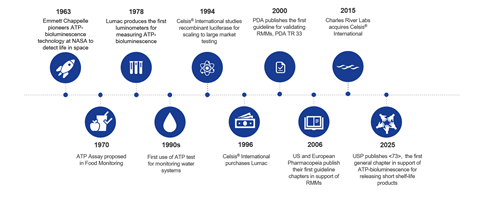
One year ago, the pharmaceutical industry celebrated an important milestone in adopting modern and rapid microbiological methods for detecting microbial contaminants in manufactured drug products. In August 2025, the US Pharmacopeia published the first general chapters supporting alternative or rapid microbiological test methods as standard test methods. This includes USP <73> ATP Bioluminescence-Based Microbiological Methods for the Detection of Contamination in Short-Life Products. This means that in the case of these pharmaceutical products, ATP-bioluminescence will no longer be considered an alternative method to the arduous 14-day sterility test and instead can be implemented upon verification of product suitability studies only. These new methods can find an equivalent result to a traditional culturing technique that is at least 50 percent faster than traditional methods. The implications of the new compendial chapters open new possibilities for assessing and releasing drug products which can be faster, more sustainable, and more reliable.
Bringing forth new test methods is no easy task, taking decades of rigorous review. As such, this is an interesting time to reflect upon the many developments and achievements of scientists and regulators in pushing boundaries to achieve modernization. Of interest, ATP bioluminescence has a long history in monitoring product quality. The following review celebrates the achievements of an industry of forward-thinkers in bringing this assay to mainstream.
A search for life in space
Firefly bioluminescence as a concept for detecting life was first brought forth by NASA scientist, Emmett Chappelle, as early as the 1950s and 60s. During this time, the interests of the public for unlocking scientific possibilities to understand outer space was at its height, culminating in the first astronauts in space, and shortly followed by the lunar landings during the 1960s and 70s. Amidst this curiosity, the possibility of using animal biochemical processes in laboratory analysis also progressed significantly.

The luciferin-luciferase reaction common to fireflies could also be utilized for detection of cellular metabolites outside of the original hosts.
While exploring new worlds, scientists were curious about the boundaries of life outside of earth, whether it exists and to what extent. With the knowledge that the luciferin-luciferase reaction common to fireflies could also be utilized for detection of cellular metabolites outside of the original hosts, Mr. Chapelle postulated that samples collected from space could be analyzed using firefly luminescence while observing for a light reaction, indicating the presence of even microbiological organisms. It is from this early work that the first ATP-bioluminescence tests were developed.
A practical use of ATP-bioluminescence
While the exploration of life outside of earth was considered fascinating in its time, and possibly still today, interest in this bioassay was more practical as food and hygiene monitoring became more controlled, making foods and personal care products safer for human consumption. As early as the 1970s, product manufacturers, stunted by the extended time-to-result offered by traditional microbiological test methods, developed interest in faster tests for finding food-borne and spoilage bacteria in support of providing products to consumers faster, fresher, and with less risk.
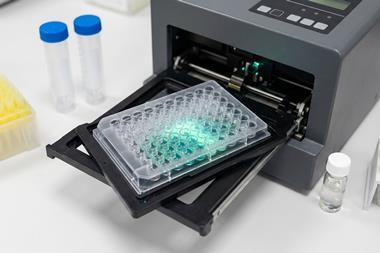
By 1978, Swedish company, Lumac, developed the first widely used bioluminometers, an instrument designed to objectively measure light values from bioluminescence reactions. Lumac developed assays for consumer products monitoring, including foods, homecare, and personal care.
Celsis® scales ATP-bioluminescence
By the mid 1990s, the practical applications of a rapid microbiological assay showed promise for saving manufacturers time and money in products distribution. In some cases, shortening product release tests meant that some warehouse footprints could be reduced or virtually eliminated as products streamlined their journeys from manufacturing floors to consumers. Everyday products such as toothpastes, shampoos, detergents, fabric softeners, foods, beverages, and more benefited from modernization.
Support of these growing consumer industries meant that a new player, Celsis International, was poised to grow the concepts earlier developed by Lumac by producing recombinant bioluminescence reagents, and significantly growing access to this valuable assay. Celsis International acquired Lumac in 1996, solidifying their presence as a global leader in ATP tests.
Charles River applies ATP-bioluminescence to pharmaceutical drugs
The greatest challenge in modernizing the microbiology lab was found in pharmaceutical drug tests. A notoriously risk-averse industry, pharmaceutical drugs must be produced under the most rigorous of standards. Further, the regulatory challenges of ensuring that alternative microbiological tests can be just as accurate or better than traditional tests is a challenge that many have shied away from for years.
Despite the publication of Parenteral Drug Association’s Technical Report 33 and multiple informational pharmacopeial chapters, there was a significant lag in the wide application of ATP-bioluminescence for final release of sterile drug products. In 2015, Charles River Labs acquired Celsis International, cementing a merger that brought together scientists and regulatory experts across industries, and bridging the divide for change.
USP publishes <73>
As a technology provider, Charles River dedicated the support network needed to achieve the next important steps in modernizing pharmacopeial regulations. Through collaborations with pharmaceutical drug manufacturers, large, small, and in between, drug product submissions to global regulatory authorities provide data demonstrating the reliability of ATP-bioluminescence at 6-7 days compared to a 14-day traditional sterility test. Time again, global regulatory authorities recognize the reliability of ATP-bioluminescence as a microbiological release test that can be both faster and objective, as it provides a computer-generated analysis in lieu of antiquated visual inspections for turbidity.
Future of rapid microbiology
QC Microbiology has progressed a long way from the early concepts of searching for life in space: the early ATP-bioluminescence assay is now a modern assay designed to provide better quality for laboratory analyses, but ultimately improvements for products and patients. Beyond the publication of USP <73>, it is important that scientists continually evolve the regulatory landscape, including regulatory modernizations of other global pharmacopeia and acceptance of rapid methods as non-alternative for all product types.
References
”A Q&A on ATP Bioluminescence Assay.” Quality Assurance & Food Safety, www.qualityassurancemag.com/article/aib1013-atp-bioluminescence-assay/.
”Emmett Chappelle and the Invention of the “Firefly” Bioluminescence Assay.” The Official Blog of Edvotek®, 27 Aug. 2020, blog.edvotek.com/2020/08/27/emmett-chappelle-and-the-invention-of-the-firefly-bioluminescent-assay/.
Pistelok, Franciszek, et al. “Using ATP Tests for Assessment of Hygiene Risks.” Ecological Chemistry and Engineering S, vol. 23, no. 2, 1 June 2016, pp. 259–270
In Modern Society, Continuously Making Technological Advancements Has Become Something of an Obsession. Staying ahead of the Game and Applying Forward-Thinking Strategies to Release the Most Innovative Solutions Is a Challenge Hygiena’s R&D Department and Team of Engineers Have Taken on for Decades. Linkedin.com, 15 Dec. 2022, www.linkedin.com/pulse/evolution-atp-hygiena/.
Pistelok, Franciszek, et al. “Using ATP Tests for Assessment of Hygiene Risks.” Ecological Chemistry and Engineering S, vol. 23, no. 2, 1 June 2016, pp. 259–270
Miller, Michael J. “A Fresh Look at USP <1223> Validation of Alternative Microbiological Methods and How the Revised Chapter Compares with PDA TR33 and the Proposed Revision to Ph. Eur. 5.1.6.” Americanpharmaceuticalreview.com, 31 July 2015, www.americanpharmaceuticalreview.com/Featured-Articles/177873-A-Fresh-Look-at-USP-1223-Validation-of-Alternative-Microbiological-Methods-and-How-the-Revised-Chapter-Compares-with-PDA-TR33-and-the-Proposed-Revision-to-Ph-Eur-5-1-6/.





No comments yet