



Laboratory automation encompasses a wide variety of systems and applications. With so many options available, it can be challenging for labs to identify the most suitable solution. To make an informed decision, labs must clearly define their needs and objectives. This article explores how automation can be strategically integrated into a workflow, either through full workflow automation or task-based automation, using a simplified qPCR example. It also outlines key considerations for protocol development.
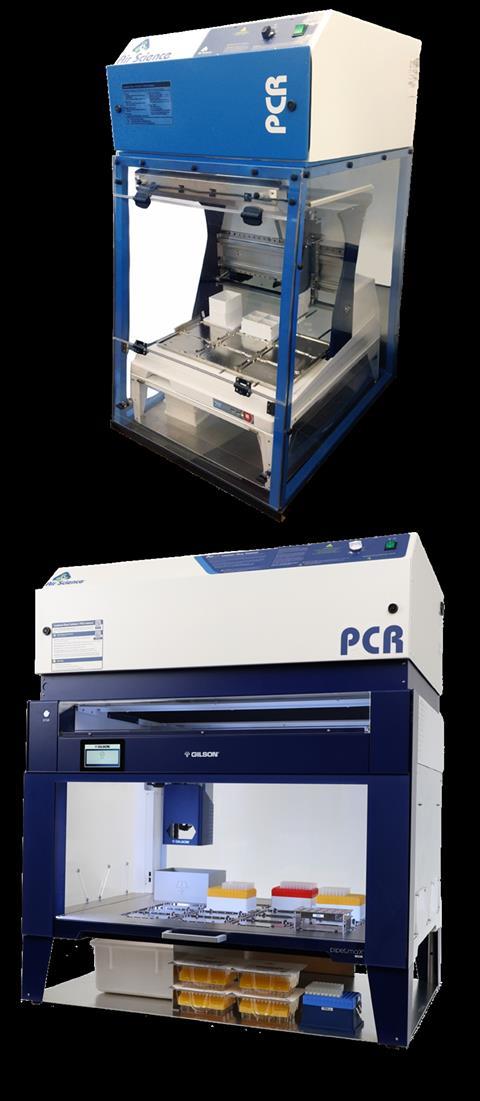
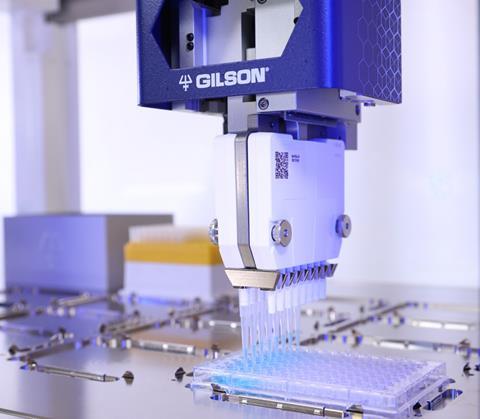
Application-based systems such as PIPETMAX® 268 qPCR and PIPETMAX® 278 qPCR allow laboratories to automate critical qPCR tasks without the complexity of full-scale robotic platforms.
Automation strategies
When automating a workflow, two main strategies should be considered: full workflow automation and task-based automation. Full automation offers a walk-away solution where the system executes the entire protocol. While convenient, it may not significantly reduce execution time but allows for fully unattended operation. Depending on the workflow, it often requires larger and more complex systems. Additionally, any system failure can halt the entire process. This strategy is particularly suitable when throughput is the main driver, especially in environments requiring robust data integration and minimal human intervention.
On the other hand, task-based automation focuses on automating specific steps within a workflow. While it requires more user interaction, it typically involves smaller systems and a lower investment. When applied to bottleneck steps, task-based automation can enhance efficiency and enable parallel processing. It also reduces errors and improves reproducibility over time and across users. This strategy is particularly relevant for results-driven labs, where manual throughput is manageable and integration into larger data systems is not required. It also makes validation faster and more straightforward.
These characteristics show how the choice between full and task-based automation depends on the lab’s operational goals. The following qPCR example illustrates how these strategies translate into practical execution.
A simplified qPCR example
PIPETMAX® 268 qPCR and PIPETMAX® 278 qPCR are application-based automation workstations designed to streamline qPCR plate preparation while improving reproducibility and reducing hands-on time. Both systems automate repetitive pipetting steps such as sample dispensing, dilution preparation, and plate setup, helping laboratories standardize workflows without the complexity of full-scale robotic automation. For the simplified workflow example below, PIPETMAX® 268 qPCR was used to demonstrate how task-based automation can improve efficiency in a typical qPCR setup.
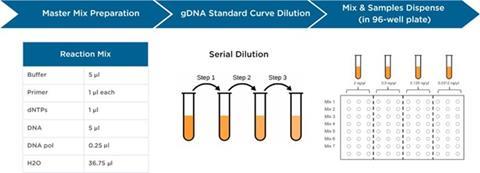
Consider a qPCR workflow comprising three main steps: MasterMix preparation, gDNA dilution, and plate dispensing (Figure 1). Manually, the completion of a complete qPCR process takes approximately 90 minutes: 45 minutes for MasterMix preparation and gDNA serial dilution, followed by another 45 minutes for dispensing both components into a 96-well qPCR plate.
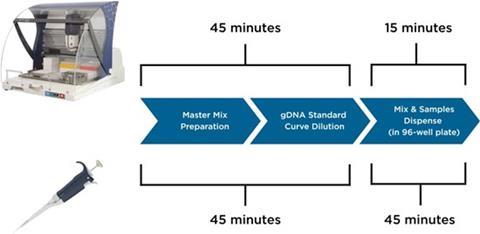
With full workflow automation, the protocol execution time is reduced by 30 minutes; approximately 45 minutes for MasterMix preparation and gDNA dilution, and 15 minutes for dispensing (Figure 2). Task-based automation achieves similar timing by automating only the dispensing step (15 minutes), while keeping reagent preparation manual (45 minutes).
While both approaches provide similar timing for a single experiment, task-based automation becomes significantly more efficient when multiple plates or workflows are processed in parallel. Now, considering two qPCR experiments, full automation would require 2 hours to process the plates sequentially (Figure 3). In contrast, task-based automation allows the second MasterMix to be prepared manually while the first plate is being dispensed, enabling the completion of both experiments in approximately 1 hour and 45 minutes. This approach would also help avoid bottlenecks at the thermocycler stage (Figure 4).

Figure 3: Task-based automation enables parallel execution and higher throughput

Figure 4: Example showing avoidance of bottlenecks at the thermocycler stage
Overall, task-based automation enables better time utilization and parallel task execution, especially when scaling up. It allows labs to process up to ten qPCR plates in an 8-hour workday, compared to eight plates with full automation, and only five plates manually (Table 1).

Table 1: qPCR plates in an 8-hour workday
Protocol development considerations
When developing protocols for automation, it is important to strike a balance between throughput, precision, and cost (Figure 6). These factors often interact, so improving one may impact the others. For example, increasing throughput might require more consumables, raising costs. Understanding these trade-offs helps in selecting the right automation strategy and system configuration.

Figure 5: Example showing avoidance of bottlenecks at the thermocycler stage
Simplify qPCR Setup with PIPETMAX® 268 and PIPETMAX® 278
PIPETMAX® 268 and PIPETMAX® 278 automates the most repetitive and error-prone steps in qPCR setup. Designed for flexibility and precision, it delivers consistent pipetting accuracy while freeing up valuable hands-on time. Ideal for labs looking to improve throughput and reproducibility without the complexity of full-scale automation.
• Automates plate setup for qPCR and other assays
• Compatible with standard labware and reagents
• Improves reproducibility and reduces human error
Scan me to explore more: