



The two-step synthesis process offers a streamlined approach that removes longstanding barriers to scalable C-glycoside manufacture for SGLT2 inhibitors.
Researchers have illustrated a new, straightforward process for synthesising carbohydrates required to produce SGLT2 inhibitors, type 2 diabetes drugs that contain C-glycosides.
While these molecules resist enzymatic breakdown, offering better metabolic stability than alternatives, they require hazardous, highly reactive reagents.
Yet, the study by scientists at Scripps Research and the University of Bristol show that it is possible to make a SGLT2 inhibitor with common reagents.
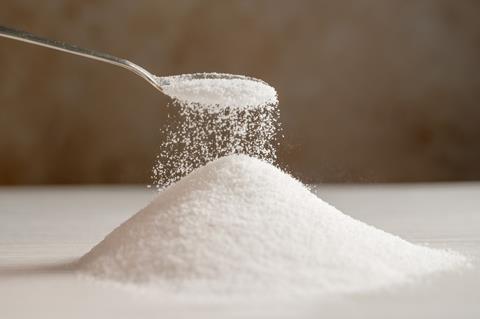
The team demonstrated a two-step synthesis of the type 2 diabetes drug Forxiga (dapagliflozin) using dextrose powder dissolved in ordinary household vinegar.
Their findings showed that a sugar molecule can be directly converted into a sulfonyl hydrazide by mixing it with a common reagent in mild acid (like acetic acid or vinegar) and leaving the product to crystallise. That single step sets up the sugar to react as a radical precursor.
Phil Baran, a professor at Scripps Research explained that this process “removes the engineering barrier to activating the radical precursor. You don’t need more complicated techniques like photochemistry, electrochemistry or stoichiometric metal salts—none of which are as easy to scale up.”
[The Baran hydrazide coupling method] removes the engineering barrier to activating the radical precursor”
Phil Baran, Scripps Research
Their findings are important because “some of the world’s best-selling diabetes drugs depend on a chemical bond that has long been notoriously difficult, slow and expensive to manufacture”. For the latter, the main issue has been swapping a sugar’s oxygen for a carbon.
Using this approach, the team made all currently approved SGLT2 inhibitors, including canagliflozin and empagliflozin, which previously required up to 20 separate synthetic steps to produce.
According to the researchers, attaching new chemical groups to other positions on a sugar molecule via the same chemistry, not just the one site relevant to SGLT2 inhibitors, could lead to entirely different classes of sugar-based compounds being built.
Varinder Aggarwal of the University of Bristol, the paper’s co-senior author, said: “Making complex molecules directly from unprotected sugars has long been a major challenge in chemistry, yet solving it could accelerate the discovery of new medicines and create shorter routes in their manufacture.
“After several unsuccessful attempts, we found that the Baran hydrazide coupling method worked exceptionally well with these sugars and so we joined forces with the team at Scripps to further develop the chemistry. Due to its operational simplicity and ready availability of the starting materials, I have no doubt it will be the method of choice to make these important molecules.”
Baran concluded that the new reaction has potential to advance drug development and manufacturing processes, “since the rate at which you can discover new drugs is tied to the rate of advancement in the field of organic chemistry”.
Moreover, the method is not patented, so it could help generic drug companies to reduce costs for patients.
The research was published in Nature.




No comments yet