


Incorporating ergonomic improvements into pharmaceutical cleanrooms may not negatively impact particle contamination control, according to a new study.
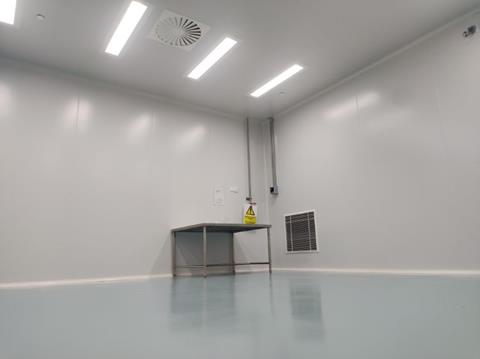
Height-adjustable furniture can be safely added into cleanrooms without compromising control of airborne contamination or compliance with ISO 14644-1, new research suggests.
In their study, Jaberi et al. measured airborne particle concentration at table heights between 70 and 120cm in an ISO Class 6 cleanroom and an industrial ISO Class 8 production line, to evaluate height effects across different airflow regimes and operational context.
Particle concentrations remained well below the permissible thresholds across all height levels. This indicates height-adjustable tables are appropriate for use in cleanrooms “regardless of whether unidirectional or turbulent mixing ventilation is employed”.
height-adjustable tables are appropriate for use in cleanrooms regardless of whether unidirectional or turbulent mixing ventilation is employed”
However, this is subject to uniform fan filter unit (FFU) placement and furniture positioning being considered during cleanroom design and qualification.
In the ISO Class 6 cleanroom, measurement height showed a statistically significant effect on particles >5 μm, “though this represented only a small contribution to the overall variance”.
A statistically significant height effect was observed for particles ≥5.0 µm in the ISO Class 6 facility.
“Particle concentrations decreased by 76 percent from 80 to 120cm due to gravitational settling. However, this effect explained only 12 percent of the total variance, with the remaining variability attributable to spatial heterogeneity in the facility’s airflow field,” Jaberi et al. wrote.
In the ISO Class 8 cleanroom, there was no significant height effect. They concluded that local differences resulted from “airflow distribution and the placement of air supply in-/outlets rather than table height”. Particle concentrations remained more than 99.99 percent below ISO Class 8 classification limits at all table positions, the authors reported.
Jaberi et al. surmised that existing facilities can therefore accommodate height-adjustable worktables with confidence while maintaining regulatory compliance.
This research offers a potential practical solution for manufacturers, seeing that existing literature has focused “predominantly on contamination control in idealised empty-room conditions or with fixed furniture arrangements, providing limited guidance for dynamic operational scenarios where workstation configurations change regularly”.
The paper was published in Applied Science.