


Authorisation is based on data showing lurbinectedin plus atezolizumab therapy facilitated a meaningful improvement in survival and progression-free outcomes compared with atezolizumab alone in ES-SCLC.
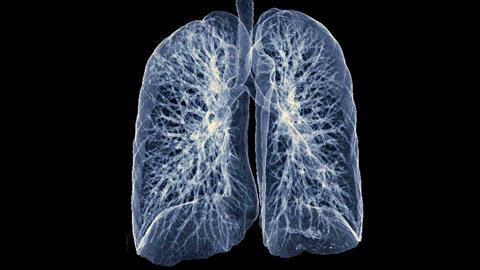
The Medicines and Healthcare products Regulatory Agency (MHRA) has approved PharmaMar’s Zepzelca (lurbinectedin) for extensive-stage small cell lung cancer (SCLC), alongside Roche’s immunotherapy atezolizumab.
The combination is authorised as a maintenance treatment in eligible adult patients. Julian Beach, MHRA Executive Director of Healthcare Quality and Access, said: “The approval of lurbinectedin provides a new treatment option for adults with extensive-stage small cell lung cancer whose disease has not progressed following initial treatment with atezolizumab, carboplatin, and etoposide.”
“The approval of lurbinectedin provides a new treatment option for adults with extensive-stage small cell lung cancer whose disease has not progressed following initial treatment with atezolizumab, carboplatin, and etoposide.”
Julian Beach, MHRA Executive Director of Healthcare Quality and Access
Administered intravenously, lurbinectedin induces cancer cell death by attaching to DNA inside cancer cells and additionally reduces immune cell activity that promotes tumour growth.
MHRA’s decision is based on data showing that lurbinectedin in combination with atezolizumab as maintenance treatment enabled participants to live for an average of 13.2 months, compared with 10.6 months for those receiving atezolizumab alone. Furthermore, the treatment also halted disease worsening by an average of 5.4 months. In those given only atezolizumab, the average was 2.1 months.
This approval follows earlier authorisation in June by the European Commission (EC) of lurbinectedin with atezolizumab as a first-line maintenance treatment for adults with this form of small cell lung cancer.
In June, GSK agreed to pay US biopharma company Nuvalent $10.6 billion to access three potential best-in-class assets in lung cancer. At the time of the announcement, Luke Miels, Chief Executive Officer, GSK, noted the acquisition provides opportunity for “significant new treatment options to patients with two forms of non-small cell lung cancer [(NSCLC)].”









No comments yet