



Research advances dry mRNA vaccine microneedle patch design, potentially improving storage and distribution of these types of vaccines.
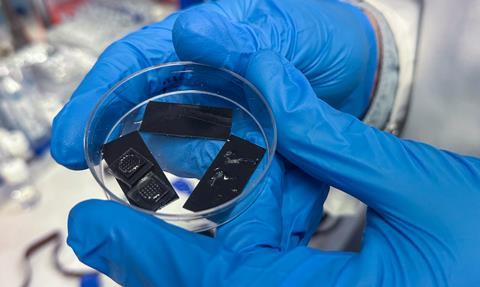
A dissolvable polymer-based printing ink can preserve mRNA-LNP motifs throughout the drying process, analysis shows. The research could help improve the design of vaccine microneedle patches and logistics of distributing these injectable alternatives.
A joint team of academic researchers from RMIT University in Australia and the Massachusetts Institute of Technology and Harvard Medical School in the US, identified that both the design of the nanoparticles and the amount of polymer used in the patch material influenced the resilience of the mRNA-carrying particles as they were dried and re-dissolved.
While the MIT researchers previously showed the patches can be printed and stored at room temperature using a model mRNA system, this latest study explains why some dry patch formulations perform better than others.
The team studied how the particles carry mRNA changed throughout the process: before drying, during drying and after rehydration. This determined which formulation conditions best preserved their structure and biological activity.
“Our study helps explain how the particles that carry mRNA respond to drying and rehydration, which is an important step towards designing future vaccine patches that are more stable and practical to distribute”
Dr Brendan Dyett, RMIT
Lead author Dr Brendan Dyett from RMIT, remarked that the findings mark progress towards improving the cost and ease of distribution of vaccines, by reducing the need for cold-chain logistics. “Many mRNA vaccines need to be stored at very low temperatures, adding cost and complexity to transport and delivery.
“Our study helps explain how the particles that carry mRNA respond to drying and rehydration, which is an important step towards designing future vaccine patches that are more stable and practical to distribute.”
Calum Drummond AO, Lead researcher at RMIT, said: “This research is helping build the foundation for microneedle patches that could make advanced vaccines and therapies simpler to use and easier to access.”
Dyett et al. noted that “as LNPs increasingly become critical excipients for the delivery of mRNA and other molecules, vaccine inks and the associated polymers will have several potential uses in medicine beyond vaccines”.
The researchers plan to further optimise the nanoparticle and patch formulations, including investigating whether similar approaches could be applied to other mRNA medicines.
The paper was published in Advanced Functional Materials.
In separate research conducted last year, Daewoong Pharmaceutical demonstrated a microneedle patch that offered the highest reported bioavailability results to date when used with the GLP drug semaglutide, an obesity medicine.





No comments yet