



Findings challenge routine use of the technique in laboratories to reduce airborne microbial contamination.
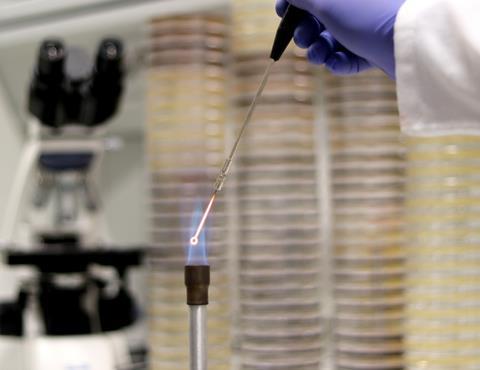
New research recommends applying 18mm Bunsen burners for laboratory asepsis only for ‘high and dry’ airborne microbial contamination, citing their activity in other contexts result in either a neutral or detrimental outcome.
Implemented as part of aseptic protocols in laboratories, Bunsen burners reduce airborne contamination by “carry[ing] airborne microbe-containing particles up and away from the materials being manipulated at a laboratory workstation”. This creates “a disinfected zone that improves asepsis”.
While the technique is promoted in “numerous textbooks, peer-reviewed publications” and beyond, according to DeVincent et al., they noted limited experimental evidence in scientific literature.
Meanwhile, the authors highlighted there currently being no formal analysis on Bunsen burner use in microbiology. Anecdotal evidence shows a range of perspectives. “Some practitioners uphold the Bunsen burner as a critical component of asepsis, while their contemporaries claim it is completely unnecessary.”
Yet others perceive that a flame “is helpful only in very contaminated environments but dispensable in ‘clean’ labs”, while others have the opinion that it worsens contamination.
Given this void of empirical data, the researchers initially hypothesised that the Bunsen burner would positively impact aseptic technique, specifically, “compared to Petri plates adjacent to an inactive burner, plates proximal to an active burner would experience reduced deposition of airborne microbe-containing particles during equivalent exposure periods”.
In their study, the team inoculated the air in a laboratory space with bacteria. Data collection focused on the deposition of airborne contaminants using a paired settle plate method.
Findings showed that an active Bunsen burner flame “does not reduce average deposition of microbe-containing particles on test plates”. This illustrates an “effectively neutral” effect of using Bunsen burners in this context in relation to asepsis.
Findings showed that an active Bunsen burner flame does not reduce average deposition of microbe-containing particles on test plates. This illustrates an effectively neutral effect of using Bunsen burners in this context in relation to asepsis”
For dry microbe-containing particulates, DeVincent et al. reported “Bunsen burner use is associated with an average increase in CFU deposition at contamination rates below the ~83 CFU/min cutoff. At settling rates >83 CFU/min, 18mm flame activity is associated with decreased deposition”.
While the study did not directly test or observe convection currents, the authors noted an unexpected finding, whereby “the duration of flame activity did not have an impact on settling rates for either burner size under any particle condition.”
DeVincent et al. theorised “that convection currents are immediately generated upon flame lighting, or that convection currents do not play as sizable or reliable a role in asepsis as has been previously conjectured”.
It is important to note that the researchers only evaluated only one working distance (10cm) from the base of the active Bunsen burner. However, “plates adjacent to an active burner [experienced] mild benefits to asepsis when baseline settling rates [exceeded] x = 83 CFU/min”.
Overall, “18mm Bunsen burner impacts on asepsis are environmentally context-dependent”. As such, “in labs where dry particle contamination is routinely detected at high levels, the investments and risks associated with Bunsen burner use are potentially justifiable”.
DeVincent et al. therefore advised that for laboratory research, “time, money, and energy will be best spent testing and implementing evidence-based best practices for laboratory asepsis that do not rely on Bunsen burners to reduce the impact of airborne contaminants”.
The paper was published in Applied and Industrial Microbiology.






No comments yet