


New microscope offers options for drug discovery, safety
Posted: 27 February 2019 | Nikki Withers (European Pharmaceutical Review) | No comments yet
Researchers have developed a microscope that may provide insight into how safely and effectively a drug will perform in the body…
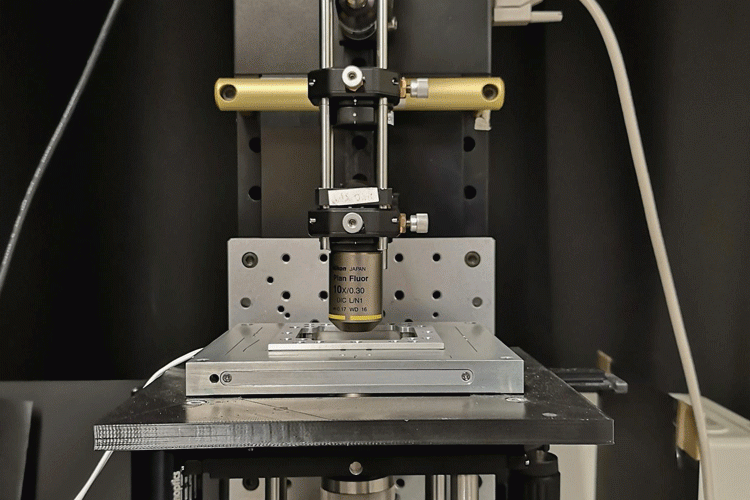
“The microscope we have created would allow for better testing of drugs,” said Garth Simpson, a professor of analytical and physical chemistry in Purdue University’s College of Science, who led the research team. “You could use our optical device to study how quickly and safely some of the active ingredients in a particular medication dissolve. They may crystallize so slowly that they pass through the body before dissolving, which significantly lowers their effectiveness.”
The microscope is based on concepts of phase-contrast microscopy, which involves using optical devices to view molecules, membranes or other nanoscale items that may be too translucent to scatter the light involved with conventional microscopes.
“One of the problems with using the available microscopes or optical devices is that they require a point of reference for the scattered light, since the object being viewed is too optically transparent to scatter the light itself,” said Simpson. “We created a unique kind of microscope that stacks the reference object and the one being examined on top of each other with our device, instead of the conventional approach of having them side by side.”
The microscope uses technology to interfere light from a sample plane and a featureless reference plane, quantitatively recovering the subtle phase shifts induced by the sample.
The team created their device by adding two small optics to the base design of a conventional microscope. The change allows researchers to gather better information and data about the object being viewed.
Simpson said the microscope developed at Purdue could also be used for other types of biological imaging, including the ability to study individual cells and membranes from the body for various medical testing.
The work is published in Optics Express