




Evolving the development of traditional enteric coatings, this new approach side steps potentially problematic manufacturing steps to deliver intact APIs where they are needed.

Oral drug delivery continues to be the preferred route of drug administration, providing a less invasive and more convenient option for patients that supports adherence and simplifies administration. Despite these benefits, oral delivery targeting the gastrointestinal tract faces multiple biological barriers which can impact a drug’s bioavailability, stability and safety.
Enteric coatings offer one approach to addressing these challenges, protecting sensitive molecules from gastric degradation and enabling their release in the intestine. This can support the oral delivery of a range of drug modalities, including peptides, proteins and RNA-based therapies.
The challenges of small-intestinal delivery
Oral therapies developed to target the small intestine initially encounter acidic conditions in the stomach (pH 1.0–2.5) before entering the intestines where the pH ranges from 6 in the duodenum to approximately 7.4 in the terminal ileum – ie, ranging from mildly acidic to mildly alkaline. These changing conditions present challenges for oral formulations, particularly those containing active pharmaceutical ingredients (APIs) that are sensitive to gastric acidity.
Enteric coatings are designed to protect APIs from degradation by acids in the stomach, while controlling the site of drug release in the small intestine, thereby reducing gastric side effects. In addition, enteric coatings can be leveraged to enable modified release of drugs, improve stability, and make therapies more patient-friendly through improved taste and, where the dosage form allows, ease of swallowing.
The application of enteric technologies is being explored across a range of drug modalities – each presenting distinct formulation challenges. For small-molecule drugs, they can help protect acid-sensitive compounds, while peptide therapeutics may require additional strategies to limit enzymatic degradation and improve intestinal permeability. Oral vaccines also depend on preserving antigen integrity, while live biotherapeutic products present the added challenge of maintaining cellular viability during formulation and encapsulation, as well as throughout gastrointestinal transit. The choice of approach therefore depends on the properties of the therapeutic, its intended site of action and the specific barriers to successful delivery.
An intrinsically enteric capsule design
Conventional enteric protection often involves applying a pH-responsive polymer coating to a filled dosage form. These coatings can protect APIs from gastric degradation and enable drug release in the intestine. However, the additional coating step can expose sensitive drug substances to heat or solvents, depending on the process and coating formulation. It also adds complexity to manufacturing, potentially increasing costs and extending production timelines.
Capsugel® Enprotect® capsule is an intrinsically enteric capsule developed by Lonza Capsugel using a novel double-dipping approach. Unlike traditional enteric capsule technologies, it eliminates the need for post-manufacturing coating while providing gastric acid resistance, customisable enteric-release profiles and compatibility with large-scale manufacturing.
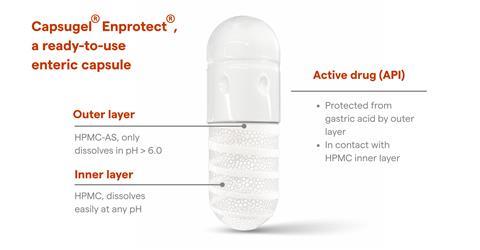
The technology is a bilayer capsule comprising an outer layer of hydroxypropyl methylcellulose acetate succinate (HPMC-AS) and an inner layer of hydroxypropyl methylcellulose (HPMC). This design protects the API against varying gastrointestinal conditions and supports targeted delivery to the small intestine.
The outer HPMC-AS layer resists acidic gastric conditions and dissolves at pH levels above 6, with dissolution occurring at approximately pH 6.2 to enable drug release in the small intestine. The inner HPMC layer, which is in direct contact with the API, dissolves readily at any pH. The capsule also incorporates a Coni-Snap® secure closure design to provide leak-free API containment and facilitate high-speed filling.
Manufacturing and delivery advantages:
- No post-filling coating or additional excipient required
- No heat sealing
- pH-responsive release to support delivery to the small intestine
- Compatibility with high-speed filling machines.
Dissolution profile testing
The coating’s dissolution profile has been evaluated in laboratory studies, with results reported to demonstrate compliance with USP requirements for dissolution of delayed-release dosage forms.
In a study using esomeprazole magnesium trihydrate (EMT) as a model acid-sensitive drug, no drug release or degradation was detected for up to two hours during the acid stage. Complete drug release occurred within 30 minutes of the buffer stage, indicating that the formulation protected the drug under acidic conditions before enabling its release in the buffer.

Figure 2: Average dissolution profile with standard deviation internal for the Capsugel® Enprotect® capsule: release of esomeprazole magnesium trihydrate (EMT) uncoated pellets from the capsule conforms to the USP esomeprazole magnesium delayed-release capsule monograph.
In further laboratory testing, the capsule showed minimal deformation after two hours in acidic conditions, maintaining its enteric properties up to pH 6.0. It opened rapidly from pH 6.4, consistent with the dissolution pH of the HPMC-AS polymer and met Ph. Eur. disintegration requirements for gastro-resistant capsules without requiring banding or sealing.
The capsule has also demonstrated compatibility with standard solid excipients, retaining its enteric properties and acid protection after six months of storage under accelerated conditions.
Evaluating performance in fasted and fed states
Variations in meal composition can impact dosage form behaviour, alongside other factors such as gastric motility, pH fluctuations, enzymatic activity and gastric emptying. In a study by Knopp et al.,1 Capsugel® Enprotect® capsules filled with a caffeine powder blend were assessed under fasted and fed conditions to test their gastric resistance. Three conditions were assessed: the fasted state, a light meal (~500 kcal) and a high-fat meal (~900 kcal). A dynamic gastrointestinal model was used to simulate the physical, hydrodynamic and biochemical conditions of the stomach.
The study found that Capsugel® Enprotect® capsules remained intact throughout gastric processing, including under fed conditions where gastric residence times were substantially prolonged. The capsules only entered the intestinal compartment after gastric emptying, with no detectable caffeine release during gastric transit.
Disintegration and subsequent caffeine release occurred only after the capsules reached the intestine, with the onset of release observed 58 (± 9), 198 (± 9) and 288 (± 9) minutes after dosing in the fasted state, the light meal and the high-fat meal, respectively. These results reinforce findings from earlier in vivo studies in healthy volunteers, which also demonstrated that the capsules maintained their gastric resistance under fasted and fed conditions.2,3
In the fed-state study, the mean gastric residence time was 158 (± 35) minutes, compared with 43 (± 18) minutes in the fasted-state study. Despite this difference, the onset of disintegration following gastric emptying was similar between the two conditions, occurring at 39 (± 21) minutes in the fed state and 45 (± 14) minutes in the fasted state, as measured by magnetic resonance imaging. Caffeine appearance measurements produced comparable results. No influence of gastric residence time on subsequent disintegration was observed, supporting the capsule’s ability to withstand prolonged gastric transit before releasing its contents in the intestine.
Supporting delivery of acid-sensitive therapies
As pharmaceutical development expands into increasingly complex drug modalities, effective delivery remains a key challenge, particularly for molecules that are sensitive to the conditions of the gastrointestinal tract. This is particularly relevant for microbiome-based therapies, where difficulties in delivering APIs effectively have prevented multiple drug candidates from progressing through development.⁴
Capsugel® Enprotect® capsule was evaluated as a delivery system for pancrelipase, an acid-sensitive combination of digestive enzymes used to treat exocrine pancreatic insufficiency, in an in vitro disease model.⁵ The effectiveness of delivery was assessed by measuring pancrelipase activity through the conversion of tributyrin to butyrate and comparing the results with those obtained using the marketed Creon® 10,000U pancrelipase capsule.

Figure 3: Pancrelipase activity determined by measuring the conversion of tributyrin to butyrate: Capsugel® Enprotect® capsules offer a similar acid protection to pancreatin than marketed enteric formulation.
The capsule supported pancrelipase delivery and enzyme activity under the tested conditions, achieving the maximum conversion rate of 66 percent. It also demonstrated a release profile and enzyme protection comparable to the Creon® reference capsule, supporting the potential of Enprotect® as a delivery system for acid-sensitive enzymes.
Tailoring capsule solutions to specific drug development needs
Different APIs present distinct formulation and delivery challenges, requiring capsule properties and release profiles to be tailored to the needs of each drug product. One example is the use of different grades of HPMC-AS to influence where an enteric capsule opens within the small intestine. HPMC-AS is available in high (H), medium (M) and low (L) substitution grades, which dissolve at different pH thresholds, offering an opportunity to adjust the release location using the same capsule platform.
A 2026 study evaluated Capsugel® prototype capsules made with HPMC-AS grades M and L, developed through Innovaform® Accelerator*, alongside Capsugel® Enprotect® capsules made with grade H in eight healthy volunteers.6 MRI tracking showed that the grade H capsules predominantly opened in the ileum, while grade M capsules opened earlier, mainly in the jejunum. Grade L capsules shifted release to more proximal sections of the gastrointestinal tract, with one opening prematurely in the stomach. These findings suggest that adjusting the HPMC-AS grade could help tailor intestinal release to specific drug delivery requirements, with grade M showing promise for more proximal release while maintaining gastric protection.
As oral drug development expands into increasingly complex modalities, delivery systems must address a wider range of formulation challenges. Alongside acid-sensitive small molecules, enteric technologies are being explored for peptides, oral vaccines and live biotherapeutic products, each with distinct requirements for protection, stability and release. Lonza Capsugel’s intrinsically enteric capsule approach protects sensitive APIs during gastric transit and supports targeted intestinal release. The ability to tailor capsule design to specific API requirements provides a potential option for developers seeking to overcome delivery challenges across a range of oral therapies.
*Innovaform® Accelerator is Capsugel’s drug delivery innovation hub, providing formulation development, capsule design and encapsulation expertise to develop customised oral and inhaled drug delivery systems. Its services support the optimisation of drug product performance, including addressing challenges such as poor solubility and bioavailability, while helping to facilitate scale-up and manufacturing.
References
- Knopp MM, Jannin V, Gonzalez V, Müllertz A. Utilizing the dynamic gastrointestinal model (DGM) to evaluate the gastric integrity of Capsugel® Enprotect® capsules in fasted and fed states. Eur J Pharm Biopharm. 2026;219:114962.
- Rump A, Kromrey M-L, Scheuch E, et al. In vivo evaluation of a gastro-resistant HPMC-based “next generation enteric” capsule. Pharmaceutics. 2022;14(10). DOI: 10.3390/pharmaceutics14101999.
- Grimm M, Rump A, Kromrey M-L, et al. In vivo evaluation of a gastro-resistant Enprotect® capsule under postprandial conditions. Pharmaceutics. 2023;15(11). DOI: 10.3390/pharmaceutics15112576.
- Markets and markets. Human microbiome market by product (prebiotics, probiotics, food, diagnostic tests, drugs), application (therapeutic, diagnostic), disease (infectious, metabolic/endocrine), research technology (genomics, proteomics, metabolomics) – Global Forecast to 2028. 2021.
- Jannin V, Duysburgh C, Gonzalez V, et al. In vitro evaluation of the gastrointestinal delivery of acid-sensitive pancrelipase in a next generation enteric capsule using an exocrine pancreatic insufficiency disease model. Int J Pharm. 2023;630:122441.
- Grimm M, Lau R, Mankertz F, et al. In vivo comparison of enteric capsule shells composed of different HPMCAS grades after simultaneous intake by dual MRI labeling and pharmacokinetics. Int J Pharm. 2026;12:100666.
Discover more about Capsugel® Enprotect®: Product information | Articles and resources










No comments yet