


A hybrid model built into commercial software and running a self-driving bioreactor has found that unmeasured cellular waste, not the usual metabolites, throttles perfusion yields.
The model first appeared in a September 2024 paper in Biotechnology Progress, co-authored by seven researchers across Sartorius, BiosanaPharma and Singapore’s A*STAR. It now ranks in the journal’s top 10 percent most-read articles. A 2025 conference poster from Chris McCready, Lukas Reger and Gerben Zijlstra has furthered the work, moving the model into cell cycle control and reporting it runs an autonomous Chinese hamster ovary (CHO) perfusion process.
Ammonia and lactate, the conventional suspects behind stalling cell growth, did not correlate with the observed growth rate. Instead, the driver was an inferred variable the authors called “biomaterial” – a catch-all for unmeasured inhibitory byproducts secreted by the cells – represented mathematically as a soft sensor rather than measured in the broth. Lysed cells (those that have ruptured and broken apart) were tracked as a separate hidden state and their accumulation accelerated the death rate of the cells still living.
“It’s always the unknown unknowns. They make biology complicated yet interesting,” Gerben Zijlstra, a bioprocess solutions expert at Sartorius, told us. “It turns out that cells produce many metabolites of which some have a strong inhibitory effect – and these are not routinely measured and therefore undefined. Interestingly, mathematically they can be represented as biomaterials in the form of a soft sensor.”
Lower perfusion rates, meaning less media exchange, improved productivity per cell”
Lower perfusion rates, meaning less media exchange, improved productivity per cell. Allowing biomaterial to accumulate triggers cell cycle arrest, enabling the cells to grow physically larger – and larger cells make more antibody. A day-by-day optimised media exchange schedule built on that mechanism produced a 50 percent increase in volumetric productivity over the best run in the training set. The model was trained on Ambr 250 bioreactors at 200mL and taken to 5L, where the first extrapolation drifted after day 12.5 and needed a sieving coefficient adjustment for filter differences between the scales. According to the authors, this is the first experimentally validated model to explain perfusion dynamics across operating conditions and scales.
The core model now sits inside Cell Insights, a cell culture digital twin tool in Sartorius’s Umetrics ecosystem, built on a one-step fed-batch-to-perfusion approach published in the journal Frontiers in Bioengineering and Biotechnology in 2022.
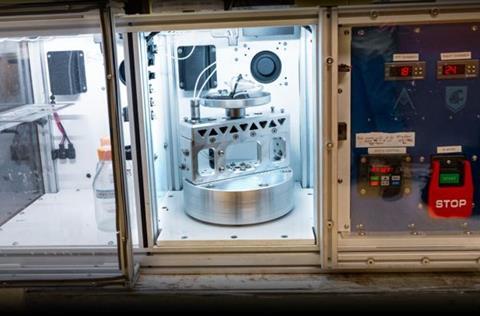
The model has also seen an autonomous run in a 2L Sartorius BDC-U system at the Sartorius Bioprocess Automation Lab at McMaster University in Hamilton, Ontario – opened in January 2025 as the first facility funded by Canada’s Biosciences Research Infrastructure Fund. McCready, Head of Product Innovation at Sartorius’s Data Analytics unit, confirmed the demonstration was wet lab, not in silico. The results are presented as conservative calculations with a 76 percent increase in production rate, a 26 percent increase in media conversion, a 35-50 percent reduction in cost of goods and run duration past 30 days, with right-first-time implementation on the first run.
Identifying those compounds directly is possible, but costly. “It would be great to explicitly identify the inhibiting compounds,” said McCready, but “in practice this takes many resources and time.” Pfizer’s cell culture group has spent years doing exactly that, using metabolomics to pin down the amino acid-derived inhibitory metabolites that accumulate in CHO cultures and engineering cell lines to stop producing them. The Sartorius model, however, skips identification and works off an unnamed variable.
Full arrest forces early termination, so the work aims at partial, controlled arrest”
The 2025 poster adds a basic cell cycle distribution layer to correlate cell size increase with the share of the population in arrest. Early results separate clones that hold a stable diameter, suited to long-term perfusion, from those that go into full arrest; this delivers high short-term productivity before viability drops, filter capacity degrades and product quality suffers. Full arrest forces early termination, so the work aims at partial, controlled arrest – enough to lift productivity without ending the run.
The model captures the gain without identifying the compounds behind it, which suits process optimisation but leaves the biology an open question.







No comments yet