




article
European Pharmaceutical Review Issue 1 2023
EPR Issue 1 includes articles on the future of pharmaceutical microbiology, separation and purification of complex biologics, the latest on nitrosamines and more...
List view / Grid view
EPR Issue 1 includes articles on the future of pharmaceutical microbiology, separation and purification of complex biologics, the latest on nitrosamines and more...


Anca Ciobanu, Strategic Theme Lead at the Pistoia Alliance, discusses the need to ensure data integrity in life sciences. She explains how data integrity can reduce costs and increase patient safety across five key areas: reproducibility, IDMP, the microbiome, semantic enrichment, artificial intelligence and machine learning.

Phoebe Chubb explores research that suggests laboratory productivity could be improved by 30 to 40 percent with digitalisation and IoT implementation.

Thermo Fisher Scientific Inc., the world leader in serving science, announced that it has acquired Core Informatics, which provides a leading cloud-based platform supporting scientific data management.
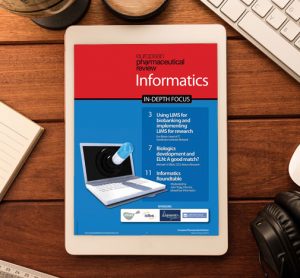

IN this Informatics In-Depth Focus: Using LIMS for biobanking and implementing LIMS for research; Biologics development and ELN: A good match?; Informatics Roundtable...


In this Informatics In-Depth Focus: Developing Informatics for the pharmaceutical industry; Rolling out a biology ELN at UCB Pharma; Ask the Informatics experts; Laboratory Informatics – Out of the fog and into the cloud?


IDBS, a global provider of innovative data management, analytics and modeling solutions, have announced that the University of Cape Town (UCT) Drug Discovery and Development Centre, H3-D (http://www.h3-d.uct.ac.za/), is using the BioBook Electronic Laboratory Notebook (ELN) to store, manage and analyze its Drug Metabolism and Pharmacokinetic (DMPK) data. Aligning itself…


13 December 2011 | By Sheraz Gul, Vice President and Head of Biology, European ScreeningPort GmbH
The pre-clinical phase of drug discovery spans a period in the region of five years and requires contributions from multi-disciplinary teams often working at different sites. These teams can generate significant amounts of data which are processed using standard as well as specialist software. The recording of a substantial amount…

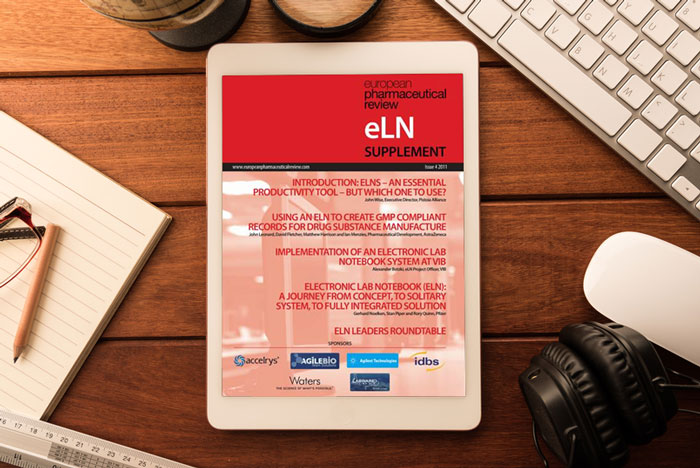
In this eLN supplement: eLNs - An essential productivity tool - but which one to use?; Using an eLN to create GMP compliant records for drug substance manufacture; Implementation of an electronic lab notebook system at VIB; eLN roundtable...

Thermo Fisher Scientific Inc., the world leader in serving science, today announced that Eastman Chemical Company, a large global manufacturer of chemicals, fibers and plastics, has expanded its deployment of Thermo Scientific SampleManager LIMS (laboratory information management system), which it has used since 2000 in its manufacturing quality control laboratories,…


Thermo Fisher Scientific Inc., the world leader in serving science, today announced that Pilgrim Software has joined the company's Informatics Global Partner Alliance. Tampa, Fla.-based Pilgrim Software, Inc. will provide integrated risk, compliance and quality management solutions to Thermo Fisher's informatics customers operating in highly regulated environments.


Thermo Fisher Scientific Inc., the world leader in serving science, today announced that Nova Biologicals, one of the nation's largest providers of laboratory testing and consultancy services to the water, environmental, medical device and pharmaceutical industries, has implemented an integrated Thermo Scientific LIMS (laboratory information management system) and NextDocs DMS…
Thermo Fisher Scientific Inc., the world leader in serving science, will showcase its new informatics offerings within booth #2835 at PITTCON 2011, being held from March 13-18 at the Georgia World Congress Center in Atlanta.
2 August 2008 | By
What were the drivers that helped launch the laboratory information management system (LIMS) and electronic laboratory notebook (ELN)? This article will trace the history of LIMS and ELN from their emergence into the future. Technology development did play a big role to be sure, but the desire of scientists to…
19 March 2008 | By
Over the past 40 years, the development of increasingly powerful computers has played a major role in the advancement of laboratory experimentation. Initially, the high processing capabilities of computers were exploited to perform complex calculations at unprecedented speeds, often offline to a company’s main frame.

