

Leftover bread could support sustainable pharmaceutical manufacturing
Posted: 23 February 2026 | Catherine Eckford (European Pharmaceutical Review) | No comments yet
The use of microbial-derived hydrogen could lead to carbon-negative, fossil-free bioproduction of pharmaceuticals.
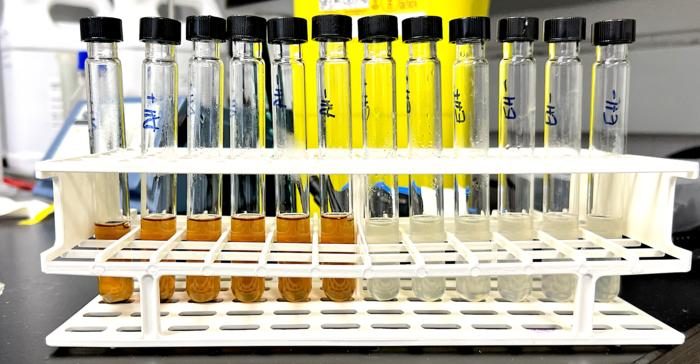
Microbial hydrogenation reactions using chemically (left) and enzymatically (right) degraded bread waste. (Credit: Dr Mirren White, School of Biological Sciences, University of Edinburgh.)
Hydrogenation can be achieved using bacteria-derived hydrogen gas, offering a potential fossil-free source for pharmaceutical manufacture.
The chemical reaction widely used for pharmaceutical manufacture traditionally utilises fossil fuel-derived hydrogen. However, the process proposed by researchers at the University of Edinburgh uses waste bread, provides a sustainable alternative.
White et al.’s study, incorporated a single, sealed flask at near-room temperature for the microbial formula.
They fed a culture of E. coli with sugars extracted from waste bread and grown without oxygen, which led to naturally-produced hydrogen gas.
Adding a small amount of palladium catalyst and a target chemical induced the hydrogenation reaction under mild, low-energy conditions.
The approach provides dual sustainable benefit. Not only does the technique remove the need for fossil fuels, but it diverts food waste. In doing so it could provide a novel avenue for bio-based manufacturing using renewable and waste-derived raw materials, White et al. said.
What we’ve shown is that living cells can supply that hydrogen directly, using waste as a feedstock, and do so in a way that can actually be carbon-negative”
Professor Stephen Wallace, Personal Chair of Chemical Biotechnology, School of Biological Sciences, University of Edinburgh, explained: “Hydrogenation underpins huge parts of modern manufacturing, but it still relies almost entirely on hydrogen made from fossil fuels. What we’ve shown is that living cells can supply that hydrogen directly, using waste as a feedstock, and do so in a way that can actually be carbon-negative.”
The paper was published in Nature Chemistry.
Biomanufacturing developments
In other biomanufacturing news, CDMO Fujifilm Biotechnologies recently expanded its Teeside facility, UK, with a £400 million investment. It is set to produce medicines and vaccines, and features 2,000 L and 5,000 L bioreactors, facilitating a total capacity of up to 19,000 L for small- and mid-scale antibody manufacturing. The site has been constructed to become fully electric and use renewable energy, supporting the firm’s sustainability efforts.
Related topics
Biopharmaceuticals, Bioproduction, Drug Manufacturing, Manufacturing, Sustainability