


You are here: Home » Archives for HCA (High Content Analysis)
HCA (High Content Analysis) - Articles and news items
Issue 3 2012 / 10 July 2012 / Anthony Mitchell Davies & Anne Marie Byrne, Department of Clinical Medicine Trinity College Dublin; Holger Erfle, BIOQUANT-Zentrum Ruprecht-Karls-Universität Heidelberg; Graham Donnelly, Rita Murray & Peadar MacGabhann, Biocroi Ltd
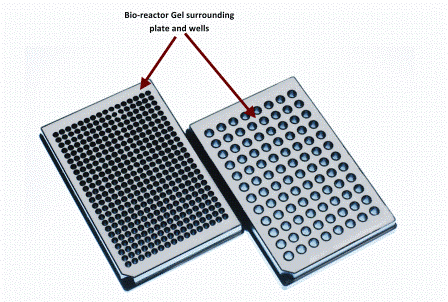
One of the major limitations of performing large-scale High Content Analysis (HCA) screens is reagent cost, indeed this fact has been a key driver in the development of assay size reduction strategies here at The Irish National Centre for High Content Screening and Analysis at Trinity College’s Department of Medicine.
As well as the obvious financial advantages of reducing assay volumes, we have also identified other key benefits to this approach, namely:
- Higher throughput
- Improved signal to noise
- Suited for the use of valuable cells, e.g. primary cells
- Reduced storage and research space
- Improved mixing of reagents
The practicalities of performing cell based assays at the nano-litre scale
Despite the clear benefits to adopting miniaturisation, there are several significant barriers that must be overcome before these methods can be utilised. These are sample delivery / handling and environmental stability. (more…)
Issue 1 2011 / 16 February 2011 / Neil Carragher, Edinburgh Cancer Research UK Centre, Institute of Genetics and Molecular Medicine, University of Edinburgh
High-content analysis is primed to play a prominent role in a new era of drug discovery research that places greater emphasis on clinical translation at all stages of the discovery process from target identification to proof-of-concept testing. High content analysis provides a technical bridge between reductionist targetdirected drug discovery approaches and new technologies that embrace the biological diversity of human disease.
The drug discovery industry is evolving rapidly, this evolution is stimulated by two key factors; (i) increased accessibility of new technologies such as next generation sequencing, systems biology and imaging that enhance our ability to interrogate complex biological systems and; (ii) the perceived failure of the widely adopted target directed drug discovery operating model to deliver novel medicines. Thus, high content imaging technologies provide a timely, pragmatic solution that enhances the effectiveness of conventional target-directed chemical approaches and provides the necessary biological context for understanding proteomic or genetic signatures. However, the future success of high-content analysis in improving the clinical success rates of drug discovery projects is entirely dependent upon the physiological relevance of the biological models under evaluation. (more…)
Issue 3 2010, Past issues / 25 June 2010 / Peter Alcock, Colin Bath, Carolyn Blackett & Peter B. Simpson, Screening & Assay Sciences, Cancer Bioscience, AstraZeneca Alderley Park
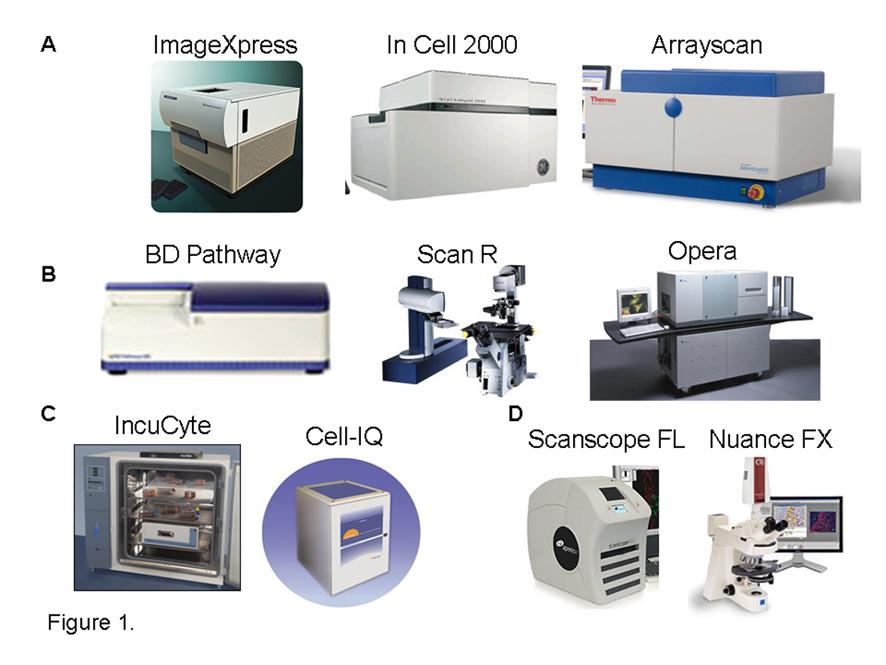
Over the last 15 years, vendors have offered microscope-based instruments capable of producing images of fluorescent labelled components of cells grown in microtitre plates. These instruments are typically bundled with analysis software capable of defining the relative distribution of several fluorescent markers on a cell by cell basis1,2. As the readers have improved and image acquisition and analysis times have reduced, the potential for screening larger compound libraries has presented itself. High Content Screening (HCS) i.e. the generation of multiparameter data from a single well, has thus become an important tool in the High-Throughput Screening (HTS) laboratory. (more…)
Issue 6 2009, Past issues / 12 December 2009 /
Coverage Includes: Compound/siRNA Screening – Pathway Analysis – Data Management – Image Analysis – HCA for Stem Cells – Live-Cell Imaging – Flow Cytometry – Neuronal Screening – New Biological Models for HCA – Novel Probes and Biosensors. (more…)
Issue 3 2009, Past issues / 29 May 2009 /
Participants:
Anthony Davies
Director of High Content Research Facility, Department of Clinical Medicine, Trinity College Dublin
Sarah Payne
Product Manager, TTP LabTech Limited
Khuong Truong
European Product Manager, BD Biosciences
Jeremy Simpson
Professor of Cell Biology, University College Dublin (UCD)
Oscar ‘Joe’ Trask
Head of Cellular Imaging Technologies, Duke University
Peter Simpson
Associate Director of Cancer Bioscience, AstraZeneca (more…)
Issue 2 2009, Past issues / 20 March 2009 /
Technological advances in robotised microscopy, liquid handling and image processing have enabled the emergence of high content screening where large numbers of specimens are automatically analysed. Here we overview the process discussing potential difficulties and solutions.
High content screening (HCS) enables the discovery of novel regulators of biological and physiological processes in an unbiased manner using light microscopy imaging. (more…)
Issue 1 2009, Past issues / 7 February 2009 /
High Content Analysis and Screening technologies (HCA) ushered in a new era in the biomedical research, enabling the scientists to uncover previously unknown disease mechanisms and to introduce innovative approaches to the development of the new generations of therapeutic drugs with a potential to selectively target individual genes, molecules and subcellular organelles. The quest for the novel therapeutic targets starting from thousands of candidate molecules and compounds, narrowing down to a few leads and their subsequent optimisation and practical application, which for many years has been almost an exclusive privilege of the large pharmaceutical companies, is quickly becoming a routine in the academic research environment.
Investigations into vast collections of small molecule chemicals, genome-wide siRNA libraries and large sets of functionalised nanomaterials for their potential biomedical utilisation, for instance, in addition to being prohibitively time-and labour-consuming by conventional methods, all inevitably generate an extensive output of information difficult for routine analysis and correct interpretation within a confined time frame and restricted resourses. HCA technology is perfectly designed to overcome these limitations, permitting for multiplexed quantitative “on the fly” processing of large massives of data, in addition giving an opportunity of detailed retrospective data analysis thereby providing efficient solutions even within the shortfalls of manpower and funding frequently experienced by academic research centres and which have a potential to become more common in the current economic situation worldwide. We provide here an overview of two extremely beneficial HCA application scenarios currently utilised by the researchers at the Institute of Molecular Medicine, Trinity College Dublin, for tackling extensive massives of experimental data in search of siRNA tools targeting inflammation-associated processes, and for screening the safety and intracellular distribution of nanomaterials with promising biomedical application potential. (more…)
Issue 6 2008, Past issues / 3 December 2008 /
Date: 5-9 January 2009
Venue: The Fairmont Hotel, San Francisco, California
Host: Cambridge Healthtech Institute
Website: http://www.highcontent analysis.com/index.asp
Last year over 400 thought leaders gathered at the Fifth Annual High-Content Analysis meeting at the San Francisco Fairmont Hotel, on 14-17 January, to discuss the latest technologies and applications in high-content analysis. This year over 400 delegates are expected to attend and over sixty speakers will appear. (more…)
Login to access exclusive content