




Permeability assessment remains a key challenge in peptide drug discovery. SFC-based EPSA analysis provides a practical way to evaluate exposed polar surface area, while combined PDA/MS detection and open-access workflows support reliable, high-throughput screening.
Built for peptide permeability studies
In peptide drug discovery, polarity remains closely linked to permeability, but calculated descriptors do not always capture how much polar surface is truly exposed. TPSA (topological polar surface area) is calculated based on molecular connectivity and does not reflect three-dimensional structure, steric conformation or intramolecular hydrogen bonding. EPSA (experimental polar surface area) is measured from SFC retention behavior and can therefore provide a more realistic view of exposed polarity, especially for cyclic peptides and other medium-sized molecules.1
A dual-detector setup for broader analyte coverage
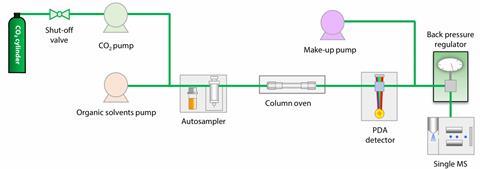
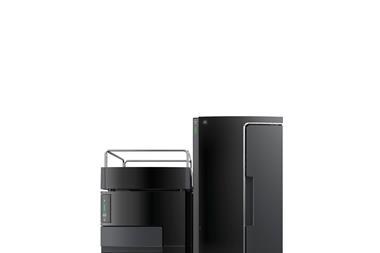
No single detector is ideal for every analyte. Photodiode array (PDA) detection is effective for compounds with UV absorption, while mass spectrometry (MS) can capture ionizable compounds that are invisible to absorbance detection. By combining a PDA detector with a single-quadrupole (SQ) MS on one analytical SFC system (Figure 1), retention times from either chromatogram can be used for EPSA calculation, extending the range of compounds that can be assessed in one workflow.
Calibrated for reliable EPSA values
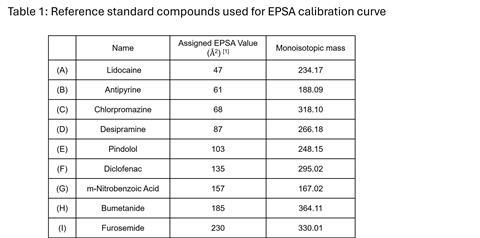
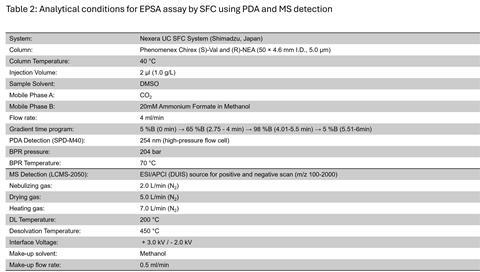
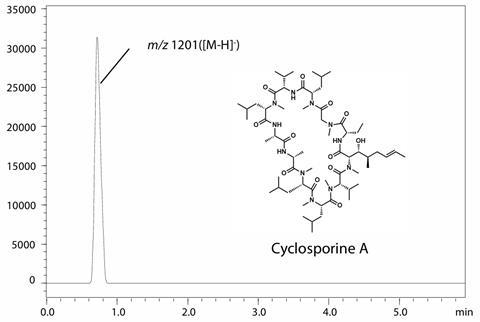
The method is anchored by a calibration curve built from nine standard compounds with assigned EPSA values ranging from 47 to 230 Ų. Under the reported SFC and MS conditions, the resulting curves showed excellent linearity, with R² values of 0.9977 using PDA retention times and 0.9976 using MS retention times. This provides a strong analytical basis for routine EPSA determination across a broad polarity range. For details on the reference compounds and analytical method, see Table 1 and Table 2 respectively. Figure 3 shows a typical MS chromatogram of the standard solution.
Relevant for challenging peptide-like compounds
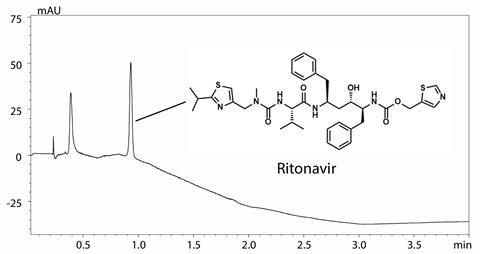
The method was then applied to two representative peptide-related compounds: cyclosporine A, a cyclic polypeptide antibiotic, and ritonavir, a peptide mimetic drug. Each sample was prepared in DMSO at 0.1 g/L and analyzed under the same chromatographic conditions used for calibration. Ritonavir was observed in the PDA chromatogram, while cyclosporine A proved difficult to detect by PDA but was detected by MS, illustrating the practical value of combining both detectors on one system (see Figure 2 and Figure 3). In both compounds, TPSA produced substantially higher values than EPSA, 278 versus 62 for cyclosporine A and 145 versus 75 for ritonavir. These differences show how strongly conformation and intramolecular interactions can affect the exposed polar surface, and why direct EPSA measurement can be more informative than topology-based prediction alone for peptide-like molecules.
Designed for efficient, open-access lab workflows
High-throughput EPSA screening depends on more than analytical performance alone. In shared discovery environments, instruments need to be ready when required and easy to use regardless of the previous operator. An open-access software solution supports this with a standardized workflow from sample registration to analysis start, automatic conditioning, scheduled startup, low-flow idling during inactivity and automatic shutdown after extended idle periods. The result is a workflow designed to keep throughput high while reducing manual effort and unnecessary solvent consumption.
Reliability built into routine operation
Because EPSA depends on retention time, instrument condition has a direct influence on data quality. Automated system suitability testing (SST), including pass/fail judgement and trend tracking is therefore not a secondary detail but a core part of result quality. As an example, an SST was based on diclofenac at 1.0 g/L in DMSO, using an acceptable retention-time window of 2.100 to 2.200 minutes. When the salt concentration in the modifier was intentionally reduced from 20 mmol/L to 10 mmol/L for one day, the result failed the criterion, showing that the system was no longer in a suitable condition for correct EPSA calculation. The open-access software’s SST Viewer function made the abnormal value and its time-dependent trend easy to identify.
A practical platform for discovery workflows
With the Nexera UC analytical SFC system, the LCMS-2050 SQMS and the Open Solution open-access software, Shimadzu offers a comprehensive, efficient workflow for EPSA measurement that combines permeability-relevant insight with operational consistency. The approach is positioned to support high-throughput processing of small-volume samples, maintain reliable data quality and help accelerate screening and candidate selection in peptide and medium-molecule research.
About the authors
Gesa Schad, Shimadzu Europa GmbH.
Shotaro Hirota, Rika Ogami and Yusuke Masuda, Shimadzu Corporation.
References
1. S. Hirota, R. Ogami, Y. Masuda, “Measurement of Experimental Polar Surface Area Using Supercritical Fluid Chromatography”, Shimadzu Application News 01-01161-EN, April 2026










No comments yet